 IndiaRummyList.YOUR NEXT GAME STARTS HERE
Rummy Variations
A practical learning guide with original examples. Start with the rules of your chosen format.
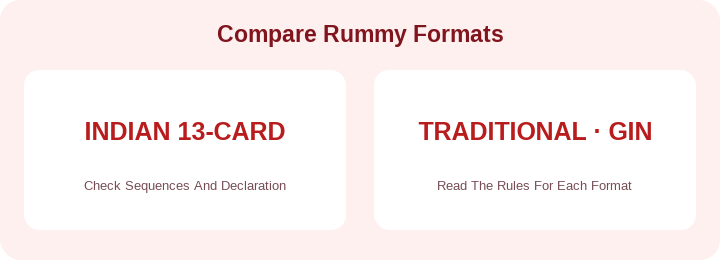
Rummy variations share a family resemblance, but the details can change the entire experience. An app name alone does not tell you how many cards are dealt, whether combinations are placed on the table or how a round ends. Use this guide to compare formats before reading a game listing.
Indian 13-Card Rummy
This is the main learning focus of IndiaRummyList. Players organise a 13-card hand into permitted combinations. A common format requires two sequences, including a pure sequence, before a valid declaration. Different apps can implement additional conditions, so read their own help pages rather than treating every product as identical.
This format may suit someone who enjoys arranging a complete hand and checking several connected requirements. Our rules guide explains the basics using original non-cash examples.
Traditional Rummy
Traditional rummy is a broad label. Some versions involve placing completed combinations on the table during play. That changes what other players can see and how you think about the cards left in your hand. A traditional-rummy guide therefore should not be used as a direct instruction manual for an Indian 13-card app.
When comparing a traditional game, look for an explanation of dealing, legal combinations, turn order and ending the round. If those points are not explained, the listing does not give enough information to judge the format.
Gin Rummy
Gin rummy is usually presented as a two-player format with its own hand-ending procedure and treatment of unmatched cards. Its terminology can sound familiar even when the required decisions differ. Do not assume that an Indian-rummy declaration checklist applies to gin.
A player looking for a focused two-player experience may want to explore a non-cash gin game, but should first read a dedicated guide for that implementation.
Other Named Formats
You may encounter names such as Rummy 500 or block rummy. Treat each name as a prompt to investigate, not a complete rules description. Different publishers may use house rules or similar marketing names for different experiences. The important question is what the specific game actually asks you to do.
Compare These Five Points
- Hand size: how many cards are dealt, and does that number change?
- Public information: are combinations kept in hand or placed on the table?
- Jokers and aces: which substitutions and placements are valid?
- Ending a round: what action completes a hand?
- Scoring: what does the app record, and what determines the final result?
Understand House Rules Before Starting
A house rule is an agreed change to a format. On an app, the published rules take the place of a table discussion. Read them before joining a session. A familiar screen layout does not prove that the rules match a game you played elsewhere.
For example, if one version treats an ace differently from another, an arrangement you remember may fail validation. The practical lesson is to check the rule rather than arguing from the game’s name.
Choose A Format That Fits Your Learning Style
- For structured hand-building practice, begin with one clearly documented format.
- For a new variation, study its ending conditions before its advanced strategy.
- For a mobile app, check text readability, controls, Android requirements and source information.
- For any unfamiliar term, use the Rummy Glossary.
Start slowly and keep play recreational. Our App directory links to information pages; a listing is not an official endorsement or a guarantee of suitability.
Explore rummy apps for Android and check each App page for the supplied version and device information. You can also compare rummy download listings without assuming that a listing is an official endorsement.