 IndiaRummyList.YOUR NEXT GAME STARTS HERE
Indian Rummy Rules
Indian rummy rules help you understand a 13-card hand before you try a rummy app. Start with the combinations, then learn the order of a turn. This guide explains a common recreational format. It is not a substitute for the instructions inside an individual game.
What Are You Trying To Make?
Your task is to organise the whole hand into permitted groups. In a common Indian 13-card format, a completed hand includes at least two sequences, one of which is pure. The remaining cards must also form valid combinations. One useful habit is to separate cards into tentative groups without forgetting that every card must eventually belong somewhere.
Understand The Three Building Blocks
Pure Sequence
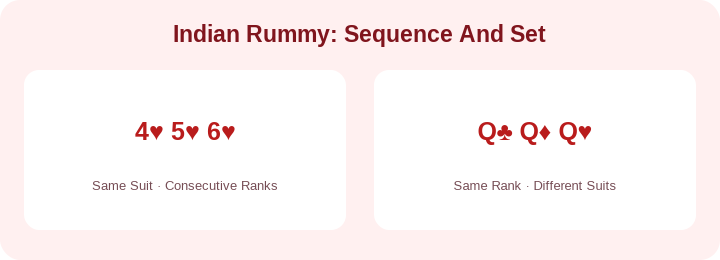
A pure sequence uses consecutive ranks in the same suit without a joker replacing a missing card. For example, 5♣, 6♣ and 7♣ fit together. By contrast, 5♣, 6♦ and 7♣ do not form a sequence because the suits do not match. Look at both rank and suit, not just the numbers.
Sequence Using A Joker
Where the rules allow it, a joker can fill a missing position. Imagine holding 9♥ and J♥ with a permitted joker standing for 10♥. This helps explain substitution, but it does not create a pure sequence. Check which cards the app treats as jokers and how it validates them.
Set
A set groups matching ranks in different suits. For practice, place Q♣, Q♦ and Q♥ together. Do not assume that two visually identical copies count as different suits. Games may differ on the permitted length of a set, so confirm the specific rule before declaring.
Follow One Turn At A Time
- Draw: take a card from a pile allowed by the game.
- Review: decide whether the new card improves an existing group or creates a better arrangement.
- Regroup: move cards within your hand if another combination works better.
- Discard: finish the turn by placing an unwanted card in the appropriate pile.
Keep the turn sequence separate from the final declaration. An attractive group of three cards is only part of the hand; it does not mean the remaining cards are valid.
Try This Original Practice Hand
Lay out these four groups: 2♠–3♠–4♠; 7♦–8♦–9♦; K♣–K♦–K♥; and 5♥–6♥–7♥–8♥. There are 13 cards in total. The example shows how complete, non-overlapping groups can cover a whole hand. It deliberately uses no jokers, so you can focus on ranks, suits and counting.
Now replace 8♦ with 8♣. The second group no longer has one matching suit. This small change demonstrates why checking the entire arrangement matters more than recognising a familiar-looking pattern.
Check Before You Declare
- Count the cards in the final arrangement.
- Identify the required pure sequence.
- Check the second sequence and all other groups.
- Make sure no card has been used twice.
- Confirm the treatment of aces, jokers and duplicate cards.
Ace placement and declaration controls can vary. Do not transfer a rule from traditional rummy or gin rummy just because an app uses the word “rummy”. If an app provides a practice table or a rules screen, use it to check your understanding.
Learn Without Rushing
Begin with simple hands and read any validation message carefully. When a hand fails, identify the exact group that caused the problem rather than repeatedly submitting it. Our rummy strategy guide offers a learning routine, and the glossary explains unfamiliar terms. Use games as recreation, take breaks and follow the Responsible Play policy.
Explore rummy apps for Android and check each App page for the supplied version and device information. You can also compare rummy download listings without assuming that a listing is an official endorsement.