 IndiaRummyList.YOUR NEXT GAME STARTS HERE
Indian Rummy Strategy
A practical learning guide with original examples. Start with the rules of your chosen format.
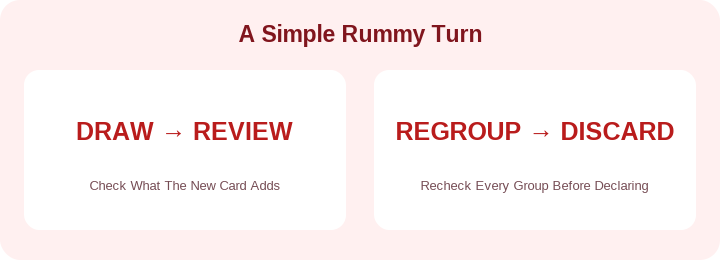
Indian rummy strategy is easier to learn when you have a repeatable way to review your hand. The aim of this page is to improve your decisions in recreational practice, not to promise wins. Random draws, other players and different rule sets mean no checklist can guarantee an outcome.
Begin With A Short Rules Check
Before choosing a move, confirm the format. How many sequences are required? Which cards act as jokers? How is a declaration checked? A technique that seems helpful in one version may be irrelevant in another. Keep the app’s rules available until the basic process feels familiar.
Sort Your Hand In Two Passes
First Pass: Find Obvious Connections
Group cards by suit and look for consecutive ranks. Then look for matching ranks across different suits. Treat these as possibilities rather than permanent decisions. A hand becomes easier to read when connected cards sit together instead of being scattered across the screen.
Second Pass: Identify Loose Cards
Mark the cards that do not currently support a useful group. Ask what each one could become after a future draw. Avoid calling a card “useless” simply because it is not part of your first arrangement; it may connect to a different plan.
Work Towards A Stable Foundation
In a common 13-card format, a pure sequence is a requirement, so it deserves attention early in your review. Once a sound group is available, consider carefully before breaking it. This is a planning habit, not an instruction to ignore every alternative. Compare what you gain with what you would need to rebuild.
Use A Three-Question Turn Routine
- What changed? Identify exactly what the new card adds to the hand.
- What improves? Compare the arrangement before and after the draw.
- What remains? Check the loose cards and the requirements you still have not met.
This keeps attention on the whole hand. It is easy to focus on one nearly finished group and overlook a different group that has become invalid.
Compare Flexible Options
For a simple practice exercise, imagine 6♣ and 7♣ together. Several nearby ranks may become relevant to that pair. Now compare them with two cards far apart in the same suit. The exercise is about recognising connections, not calculating a guaranteed best move. Actual decisions depend on the rest of the hand and the rules.
Jokers can create additional options, but an arrangement that relies on a joker may still leave the pure-sequence requirement unresolved. Label the role of every joker in your planned groups so you do not accidentally count it in two places.
Observe Only Information The Game Makes Public
Notice visible actions, such as cards added to an open pile, without assuming you know another player’s full hand. Observations are incomplete. Use them as context rather than proof. Do not use prohibited automation, hidden-information tools, collusion or any software that breaks the publisher’s rules.
Review Mistakes After A Practice Hand
- Was the problem a rule misunderstanding or a missed connection?
- Did a useful group get broken without checking the consequences?
- Were the cards counted correctly?
- Did rushing cause an invalid declaration?
Choose one improvement for the next hand. Trying to change every habit at once makes it harder to see which adjustment helped. Stop when tired, distracted or frustrated.
A Simple Learning Plan
First, practise recognising sequences and sets. Next, practise sorting a full hand. Then add the three-question routine. Finally, review declaration checks. You can use paper examples when no suitable non-cash practice mode is available. Read Indian Rummy Rules for the requirements and Rummy Variations before moving to another format.
Explore rummy apps for Android and check each App page for the supplied version and device information. You can also compare rummy download listings without assuming that a listing is an official endorsement.